Everything You Need to Know About What a Catholic Saint Is
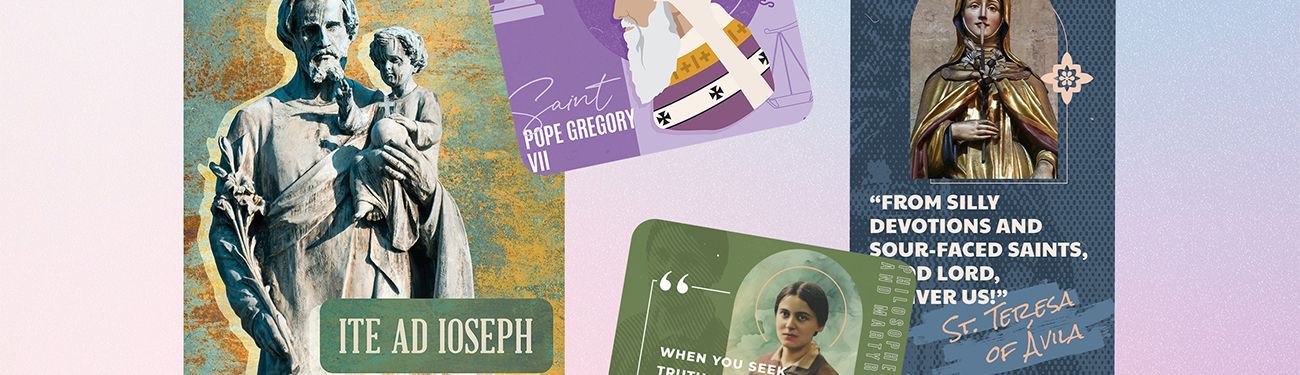
At LPi, we work with thousands of Catholic parishes across the United States to make their parish communications shine. One thing that we’re proud to offer parishes who publish their bulletins and their church websites with us is content about Catholic saints they can use and distribute to their members. We provide illustrations of saints and other Catholic holy people, graphics with saint quotes, and saint biographies for parish bulletins and more!
That being said, we thought it would be important to publish a blog that covers the basics of what a saint is and explains a little about the process of becoming a Catholic saint. We cover questions like “How does someone become a saint?” and “What is a saint feast day?” along with many more.
Let’s dive in!
What Is a Saint?
If searching “What is a saint?” brought you to this post, you're not alone. Whether you're new to the Catholic faith, have been attending Mass for years, or are simply a curious visitor, understanding what a saint is helps explain an important part of Catholic Christian belief and tradition.
In its most basic, biblical sense, the word saint refers to someone who is in heaven with God.
So, what is a saint in the Catholic Church today? Although the Church teaches that every person who is in heaven is a saint, some of these holy people have been officially recognized through the canonization process because the story of their lives provides extraordinary examples of faith, hope, and love. These canonized saints are held up as models of Christian living and are believed to intercede for us before God. These canonized saints are usually what people are referring to when they ask, “What is a Catholic saint?”
Ultimately, saints remind us that holiness isn't reserved for a select few. God calls every Christian to grow in faith and strive for the fullness of life with Him. Catholics even have an entire holiday dedicated to honoring the saints. It's called "All Saints Day" and it is held on November 1 every year.
How Does Someone Become a Saint?
The Catholic Church follows a careful and often lengthy process called canonization to determine whether a deceased person should be officially recognized as a canonized saint. Rather than "making" someone a saint, the Church has specific ways it investigates whether the person could already be in heaven with God and if they lived a life worthy of imitation.
The process typically includes four stages and doesn’t start until five years after the person’s death. The pope can intervene in this process and dispense the 5-year waiting period if he finds reason to do so. The stages are:
- Servant of God: A bishop opens a formal investigation into the person's life, usually after being formally petitioned by the candidate’s family or people who have been impacted in some way. They investigate the candidate’s life, writings, and reputation for holiness, among other things. This marks the official beginning of the candidate’s cause for canonization.
- Venerable: If the Vatican determines that the person lived a life of heroic virtue or gave their life for their faith in Jesus, the pope then declares them "Venerable."
- Blessed/Beatified: For most candidates, in order to be beatified, the Church must verify that one miracle is attributed to the candidate’s intercession after their death. Candidates with one miracle are declared “Blessed.” An exception is that those who are martyrs may be beatified without a miracle.
- Saint: To become a canonized saint, a second verified miracle is normally required after beatification. Once the pope approves the canonization, the candidate is recognized as a saint by the universal Catholic Church.
Why Are Verified Miracles Required to Become a Saint in the Catholic Church?
Miracles play an important role in the process of becoming a saint in the Catholic Church because they are understood as signs that the person is verified to be with God in heaven and can intercede for those who pray through them.
Claims of miracles undergo extensive investigation by medical experts (if the miracle is medical), theologians, and Church officials before they are accepted as an officially verified miracle. Although the pope can make exceptions in certain circumstances, the process is intentionally thorough to ensure that every canonized saint is presented as a trustworthy model of Christian holiness.
How Many Saints Are in the Catholic Church?
The short answer is that no one knows the exact number of how many official saints thre are in the Catholic church. The U.S. Conference of Catholic Bishops notes that no precise count exists for all those proclaimed saints since the beginning of Christianity because recognition developed over time. Many names of the saints of antiquity may have been lost before today's formal canonization process existed.
Since the formal canonization process has been in place, the Roman Catholic Church has officially canonized thousands of saints. New saints continue to be canonized even today as the Church completes the careful process of investigating their lives and witness. The official list of Catholic saints is published under the name Martyrologium Romanum. Since the most recent version was published in 2004, more than 1,000 saints have been canonized by the Church and thus have not been included.
Although an official, Vatican-approved English translation of the Martyrologium Romanum does not exist, the Boston Catholic Journal provides an unauthorized translation. The saints in the publication are listed according to their feast days.
What Is a Patron Saint?
A patron saint is a saint who is recognized as a special advocate or protector for a particular person, group, place, occupation, situation, or cause. While every saint can intercede for us to God through prayer in a general way, patron saints are often chosen for their intercession because their lives closely relate to a specific need, experience, or even vocation.
In Catholicism, it’s possible to find a patron saint connected to nearly every aspect of life. There are patron saints of occupations, such as St. Joseph for woodworkers, St. Luke for physicians, and St. Thomas More for lawyers. Countries and cities often have their own patron saints, like St. Patrick for Ireland and St. Francis of Assisi for San Francisco, California — a fantastic example because the city is literally named for its patron saint. Other saints are known for particular causes or life situations, including St. Valentine, the patron saint of marriages, St. Monica, the patron saint of children, and St. Christopher, the patron saint of traveling.
What is a Confirmation Patron Saint?
Choosing a personal patron saint is often an important part of the Catholic Sacrament of Confirmation. Confirmation candidates are encouraged to pick a saint’s name to be their Confirmation name when they receive the sacrament. The practice is to choose a patron saint whose life, interests, or special dates are relatable to your own life in some way. Some choose their patron saint by discovering what saint shares their birth date or is the patron saint of one of their special interests. Then, when the candidate is officially confirmed, they are confirmed under the name of the patron saint that they have chosen.
Why Are Catholic Churches Named After Saints?
Did you know that most Catholic parishes are also named after a patron saint? That’s why so many catholic church names start with the word “saint.” Naming a church after a patron saint gives the parish community a faithful example of a Catholic life to follow and a heavenly intercessor to whom they can collectively turn to in prayer. Catholic parishes who adopt names of patron saints often also do something special on their
patron saint’s feast day.
What is a Saint Feast Day?
A saint feast day is the day the Catholic Church sets aside to remember a saint's life, thank God for their witness, and ask for their prayers. It is common for the church to set a saint’s feast day on the same date as the saint’s death because that marks the day that they entered heaven and eternal life with Jesus. In some cases, another date is chosen if the original day conflicts with a different major feast or liturgical season. These dates could be chosen by the saint’s birthday, or via a different date that marks something special that happened in their life.
Many saints have special traditions attached to how people celebrate their specific feast day. These traditions are often highly cultural and local to different communities. Some common saint feast day traditions in the United States include:
- St. Valentine’s Day, February 14: People share notes and gifts of love to romantic partners and family members.
- St. Nicholas Day, December 5: Children leave shoes or stockings out, often near a fireplace if they have one, on the night of December 5. In the morning they find that “St. Nick” has filled them with small gifts, candy, and oranges.
- St. Patrick’s Day, March 17: Entire communities honor the patron saint of Ireland on his feast day by cooking traditional Irish meals and drinking Irish drinks. Another custom for this feast day is to decorate with and wear green clothing with shamrock visuals because St. Patrick used a three-leafed shamrock to teach the concept of the Holy Trinity to the Irish people.
Whether you celebrate the feast day of a parish's patron, a Confirmation saint, or another saint who inspires you, these observances remind Catholics that the saints remain an important part of the Kingdom of God. The lives of the saints continue to point us toward Jesus through their example of faithful living, and their feast days are worth taking the time to celebrate!
Do Catholics Pray to Saints or Worship Saints?
It’s not uncommon for those outside of the Catholic faith to ask, “Do Catholics worship saints?” or “Do Catholics pray to saints?” In fact, it’s a common topic when discussing saints with non-Catholic people. Here are the facts:
Do Catholics Worship Saints?
No, Catholics do not worship saints, but they do venerate saints. In Catholicism, “to worship” means to adore and make sacrifices to/for. The act of worshiping is reserved specifically for God alone. This means that Catholics only worship God the Father, Jesus, and the Holy Spirit because Catholics believe that all three, called the Trinity, represent the One True God. Only God should be worshiped; nothing else.
Instead, Catholics venerate saints. To venerate a saint means to give the saint respect and honor due to their holy lives and close connection to God. Saints are not worshiped in the Catholic faith, but honored and respected.
Do Catholics Pray to Saints?
No, Catholics do not pray to saints. They do, however, ask saints to pray for them! Catholics believe that a saint is with God in heaven, so even though a saint has passed away, they are alive in the afterlife with Jesus. For this reason, they are considered active participants in the Kingdom of God and able to pray for someone just like a friend might pray for a friend. Catholics believe that a saint’s prayers may even be stronger or more special because they are in heaven with Jesus and in close proximity to the divine!
Asking a saint to pray for yourself or for someone or something is called “intercession.” When you ask for the intercession of a saint, you are asking them to pray on your behalf. This is why Catholics are often heard reciting phrases like “Holy Mary, Mother of God, pray for us,” or “St. Anthony, pray for me.”
Every saint has a unique story, but they all point to the same truth: God calls each of us to holiness, and with His grace, that invitation is open to everyone. This is the message Pope Francis spoke in his address to those gathered in St. Peter’s Square at the Vatican on the Feast of All Saints in 2023. Read his address here.
Share
You might also like
LPi Blog